

An AI agent can visit a website, read it and fill in a form for someone. Here is what Agentic Browsing means and why your site should be ready.
Your website has a new kind of visitor
For a long time, a website had two kinds of visitors: real people, and search engine robots that read pages to rank them. A third kind is arriving: AI agents. These are programs that browse the web for someone. They open pages, click links, fill in forms, and can sometimes go as far as placing an order.
This is called Agentic Browsing. It is still new, and most purchases are still made by people themselves. But Google takes it seriously: in 2026 it added an "Agentic Browsing" check to its PageSpeed Insights tool, shown next to the speed scores.
What is Agentic Browsing, in plain words?
An AI agent is an assistant that acts for a person. Agentic Browsing is its ability to open a website, understand what is on it and complete a task there, the way a person would.
The person gives it a goal, for example "find a mattress delivered in Algiers under a certain price" or "book a dentist appointment this week". The agent visits websites, reads them, then comes back with a short list or finishes the task itself.
For your business, this means software may read your website and decide in a few seconds whether to recommend you. If it can't find your prices or can't make sense of your form, it moves on to the next site.
Agentic Browsing and AI SEO (GEO): what's the difference?
People often confuse it with AI SEO, also called GEO, but the two measure different things.
AI SEO aims to get your business named when someone asks ChatGPT, Gemini or Google's AI Overview a question.
Agentic Browsing comes next: once an agent is on your site, can it read the page and do something there, like check a price, fill in your contact form or complete an order? A business can be mentioned by an AI and still lose the customer because its page is slow, confusing or broken.
The two go together. Good SEO and AI SEO help people find you. A site that is ready for agents lets them take action once they arrive.
Why it's worth paying attention now
The big AI companies already offer agents that can browse real websites and click real buttons. Nobody knows yet how quickly people will start using them for everyday shopping.
What we do know is that the changes that help an agent also help your human visitors: a stable page, a clear form, prices written as text. Getting ready costs little and makes the site better for everyone. A business with only a Facebook page misses the customers who search on Google instead, and in the same way, a site that agents can't read may miss the people who use them.
What makes a website ready for AI agents
- Fast loading: an agent, like a person, gives up on a page that is too slow.
- A page that doesn't jump around while it loads: if a button moves at the last moment, the agent can click in the wrong place.
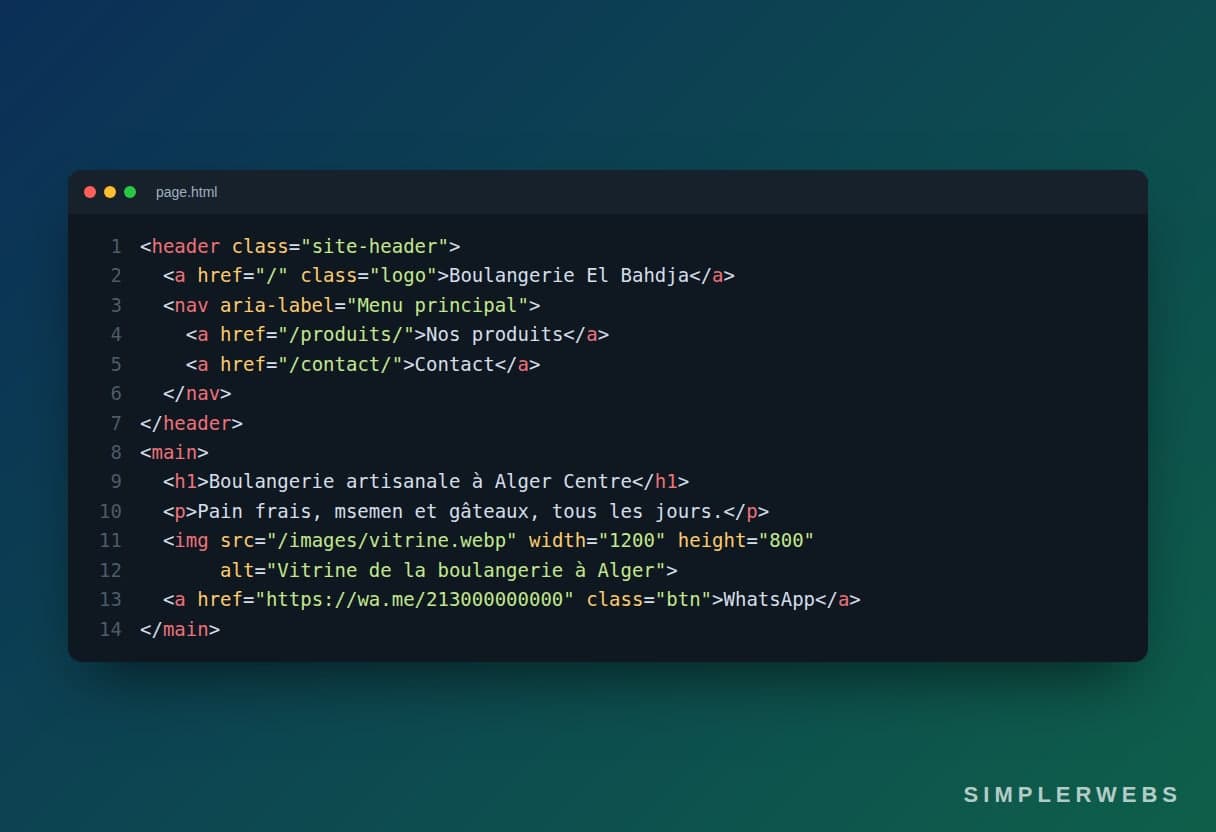
- Real, well-structured HTML: clear headings, and buttons and form fields with proper labels. This also helps people who use screen readers.
- Information written as text: your prices, hours and services should not be hidden inside images.
- No needless obstacles: a big popup covering the page, or content buried behind several clicks, can stop an agent just as it stops a visitor.
- Structured data (schema.org) that describes your products, your prices and your business.
- An llms.txt file (optional): a short summary of your business meant for AI tools.
What the PageSpeed Insights check looks at
The "Agentic Browsing" check is part of Lighthouse, the Google tool behind PageSpeed Insights. It is still experimental. It doesn't give a score out of 100, but a result like 2/3 or 3/3.
In PageSpeed Insights it runs three checks: how an agent reads the structure of the page (the accessibility tree), how stable the page is while it loads, and the llms.txt file. If that file doesn't exist, the check is marked "not applicable" rather than failed, because the file is optional.
Comfy Mattress, a site we built in Algiers, gets 3/3, with 100 in all four speed and quality scores on mobile. Prayer Travel Services, a WordPress site we built, gets 1/3: it ranks well on Google, but there is still work to do on this side.
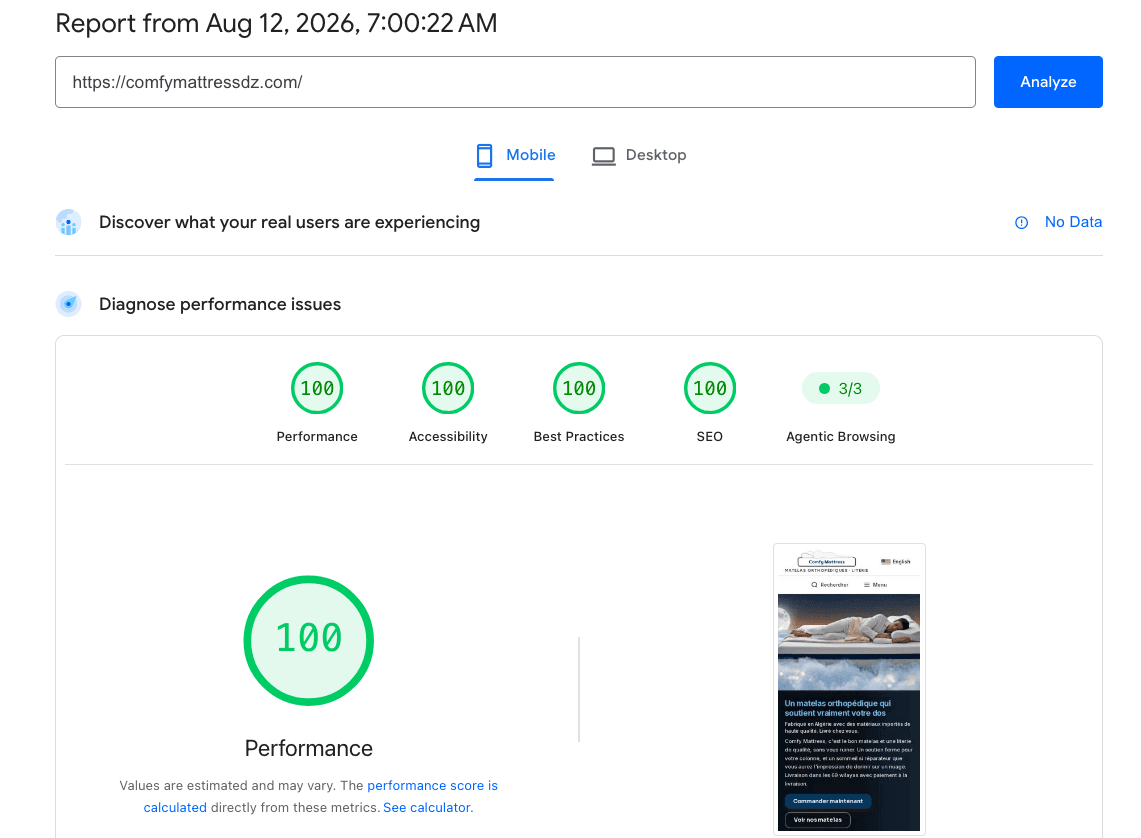
Performance 100 · Accessibility 100 · Best Practices 100 · SEO 100 · Agentic 3/3
What you gain
- Your website still works when a customer uses an AI agent instead of opening a browser themselves.
- The same fixes (clean structure, a stable page, clear content) improve the experience for human visitors and help your regular SEO.
- A well-structured site also looks more serious and organized to a person.
- You avoid rushed repairs later, if agents become common.
What happens if your site isn't ready
A site that isn't ready doesn't show any error. The agent can't find the price, can't read the opening hours or can't fill in the form, so it moves on to the next site.
And you never see it happen. No complaint and no error message warns you. The customer simply went somewhere else.
How an AI agent reads your page
An AI agent doesn't look at your website like a customer in a hurry, scrolling on a phone. It reads it more like a very careful visitor, or like Google's robot: it looks for text, headings and buttons that say clearly what they do.
It doesn't guess. If a button shows only an icon with no name, it can't always tell what the button is for. If your price is written inside a nice image, it may not see it at all. A person can understand a photo of a menu. An agent much prefers a menu written as text.
There is another point: an agent compares. The person asked it for an answer, not a visit. It reads several sites, keeps the ones where it quickly finds what it needs, and drops the rest. Your site is no longer judged only on how it looks, but on how clearly it says things.
"Price in DM": a habit that blocks agents
On Facebook and Instagram in Algeria, you often see "price in DM" or "contact us for the price". Some sellers do it so competitors can't see their prices. Others mainly want to start a conversation.
For an AI agent, that is a dead end. It can't always send a private message, wait for an answer in the evening, then discuss the price. It looks for a written price. If it doesn't find one, it notes that the information is missing and moves on to a business that shows it.
Many human customers react the same way. They don't want to write to five sellers just to compare. A visible price saves everyone time, and it filters out requests that aren't a good fit for you.
You don't have to show everything. For a service that depends on the job or the quantity, a "from" price, a price range, or a sentence explaining what changes the price is often enough. What matters is that a visitor, human or agent, leaves with a clear idea.
Accurate information everywhere, not just on your site
An AI agent doesn't read only your website. It may also look at your Google Business Profile, your Facebook page, directories or reviews. If these sources don't say the same thing, it hesitates, just as a customer would.
The most common gaps are simple: an old phone number left on Facebook, an address changed on the site but not on Google, opening hours that don't account for Ramadan or the Eid holidays, a service you stopped offering that still shows up somewhere.
This kind of mistake already costs customers today. With agents, it can cost more. If an agent gives someone the wrong opening hours or an outdated price taken from an old page, it is your business that looks unreliable.
Trust is built on details people can check: a name, an address and a phone number that work, real reviews and replies to those reviews. Nothing new, but it matters even more when software does the sorting for the customer.
What does it mean for a small business in Algeria?
Let's be honest: today, most of your customers call you, write to you on WhatsApp or come to the shop. Cash on delivery is still the norm, and many orders are confirmed by a phone call. AI agents won't change that overnight.
The people likely to use them first fit certain profiles: businesses looking for a supplier, customers used to online tools, Algerians abroad arranging a purchase or a service for their family, or foreign visitors. For some trades, these are exactly the customers worth reaching.
One point deserves your attention. If your whole ordering process happens on WhatsApp, an agent may find your number but go no further. A clear page with your services, your prices and a simple form gives you one more way in, without taking anything away from WhatsApp. Our article on WhatsApp and your website explains how the two work together.
Language matters too. If your customers search in Arabic or French, your text needs to exist in those languages, written as real text, not only inside images.
Forms: where everything is decided
The form is often the last step: booking an appointment, asking for a quote, placing an order. It is also where an agent, like a person, gives up most easily.
There is a balance to find. You want to protect yourself from spam without shutting out real customers. That setting is decided case by case, based on your business and how many requests you receive.
Problems rarely come from one big flaw. It is usually a series of small obstacles:
- Too many fields, some of them useless for a first request.
- Fields with no clear label, where you have to guess what is expected.
- A vague error message, or no message at all when something goes wrong.
- Spam protection so strict that it also gets in the way of real customers.
- No confirmation after sending, so nobody knows whether the request went through.
What not to spend money on
As with every new topic, offers appear fast. Some promise to "optimize your site for AI agents" with precise results. Nobody can guarantee that an agent will recommend you, or how long it would take.
If your budget is tight, put it into the basics first: a fast site, prices and hours written as text, accurate information everywhere. These are the same basics that already help your customers today.
Before you pay, be especially careful with these promises:
- An AI-ready "certification" or "label". There is no official label that makes agents choose you.
- An llms.txt file sold as a miracle fix. It is optional, and Google says it doesn't need one for its rankings.
- Dozens of pages mass-produced "for AI". Empty content helps neither your customers, nor Google, nor agents.
- A chatbot added to your site in the belief that it makes the site readable for agents. These are two different things.
- A full redesign when your site is already fast and clear. Often, a few targeted fixes are enough.
How SimplerWebs gets your site ready
- We test your current site with PageSpeed Insights' Agentic Browsing check and look at every point that fails.
- We clean up the structure: headings, buttons, forms, and schema.org data on your pages.
- We add an llms.txt file and rewrite unclear text so it makes sense the first time, for a person and for an agent.
- We work on page speed and stability, as on every project.
- This work is part of our technical SEO and AI SEO services. There's no need to rebuild your site.
Signs your site isn't ready
You don't need to be technical to spot the most common problems. They often show at first glance:
- Your site takes several seconds to appear on a phone, or things jump around while it loads.
- Your prices, hours or menu exist only as images or PDFs.
- Your contact form has fields with no clear label, or it fails without saying why.
- A big popup covers the page as soon as someone arrives.
- The Agentic Browsing result in PageSpeed Insights shows 1/3 or 2/3, and you don't know why.
- If your site matches any of these, ask us for a check: we tell you what is blocking and what it costs to fix.
In short
Agentic Browsing means AI agents that visit websites and take actions on them for a real person. It adds to regular SEO and AI SEO without replacing them.
A fast, stable, well-structured website already does most of the work. The rest takes careful technical work, page by page.
Want to know where your site stands? We can look at it and give you an honest answer, with no commitment.
Frequently asked questions
What is Agentic Browsing in one sentence?
It is the ability of an AI agent, acting for a real person, to visit your website, understand it and complete a task there, like checking a price or filling in a form.
Is Agentic Browsing the same as AI SEO or GEO?
No, but the two go together. AI SEO (GEO) helps your business get mentioned in an AI's answer. Agentic Browsing measures whether an AI agent can then read your site and act on it. See our AI SEO services for the first part.
Do I need a new website to be ready for AI agents?
Usually not. We fix your current site: structure, forms, page stability and structured data. A fast, well-built site already meets most of the requirements.
How is the Agentic Browsing score measured?
By the experimental "Agentic Browsing" check in PageSpeed Insights. It looks at the page structure as an agent reads it, how stable the page is while loading, and the llms.txt file. The result shows as 2/3 or 3/3, next to the speed scores.
Is an llms.txt file required?
No. It is optional, and PageSpeed doesn't count it as a failure if it is missing. Google also says it doesn't need one for its own rankings. It does no harm and may help other AI tools, but the structure and content of your pages matter much more.
Can a WordPress site be ready for AI agents?
Yes, with the right setup, but it often takes more work than a Next.js site, especially when the theme and plugins load a lot of extra elements. The principles are the same: fast loading, a stable page and a clean structure.
Will AI agents replace human visitors to my website?
No. Most customers still browse and decide for themselves. AI agents are one more channel. Getting ready costs little and also makes the site better for your human visitors.
Should I block AI agents from my website?
Usually not. Blocking every AI tool can make you invisible to customers who use them. What matters is protecting your forms from spam and staying in control of what is public. The right setting depends on your business, and we can look at it with you.
Can an AI agent read a website in Arabic?
Generally yes, when it is real text. AI tools read Arabic and French written on the page. The problem is text placed inside images or posters: it stays hard to read for an agent, just as it is for Google.
My business works mostly through WhatsApp. Is that a problem?
No, WhatsApp is still a very good channel in Algeria. The risk only appears if all your information lives in private conversations. A page with your services, your prices and your contact details written as text lets an agent, and a new customer, understand you before they write to you.