

Comfy Mattress, a mattress shop in Algiers, scores 100/100/100/100 on Google PageSpeed. The technical choices behind it, without jargon.
What does a PageSpeed score actually mean?
The website of Comfy Mattress, a mattress shop in Algiers, scores 100 out of 100 on Google PageSpeed. That covers more than speed: 100 for performance, 100 for accessibility, 100 for best practices and 100 for SEO, on both mobile and desktop.
Many people see this score as a number for developers. It actually measures something very concrete: what a customer goes through when they open your site on their phone. A high score means a page that shows up fast, that everyone can read, and that Google understands easily.
Below, in plain words, is how we got there, and what it changes for a shop like Comfy Mattress.
Comfy Mattress, before the website
Comfy Mattress sells mattresses, pillows and bedding in Algiers. The owner runs the shop on his own. It sits in Sidi M'hamed, a little way off the main Hassiba Ben Bouali avenue.
Before we worked together, the business had no online presence at all: no website, no Google Business Profile, no social media. People all over Algiers were searching for a good mattress on their phones and never came across the shop. For them to find it, the shop needed a fast website and a complete Google Business Profile.
Why speed matters so much
In Algeria, most customers open websites on their phone, often on an average connection. When a page takes several seconds to appear, many visitors leave before they see a single product.
Google pays attention to that experience. Speed is one of the signals it looks at, alongside the content and the site's reputation. So a slow site loses impatient visitors, and it also starts at a disadvantage in search results.
The proof, in real numbers
This is the real Google PageSpeed Insights report for the Comfy Mattress website. 100 for performance, 100 for accessibility, 100 for best practices and 100 for SEO, on mobile and desktop, plus 3/3 for Agentic Browsing, the score that checks whether a site is ready for AI answer engines.
The site has only just launched, so Google doesn't yet have enough real visits to show its field data ("Discover what your real users are experiencing"). That doesn't change the technical score above. The field data will appear over time as visits build up.
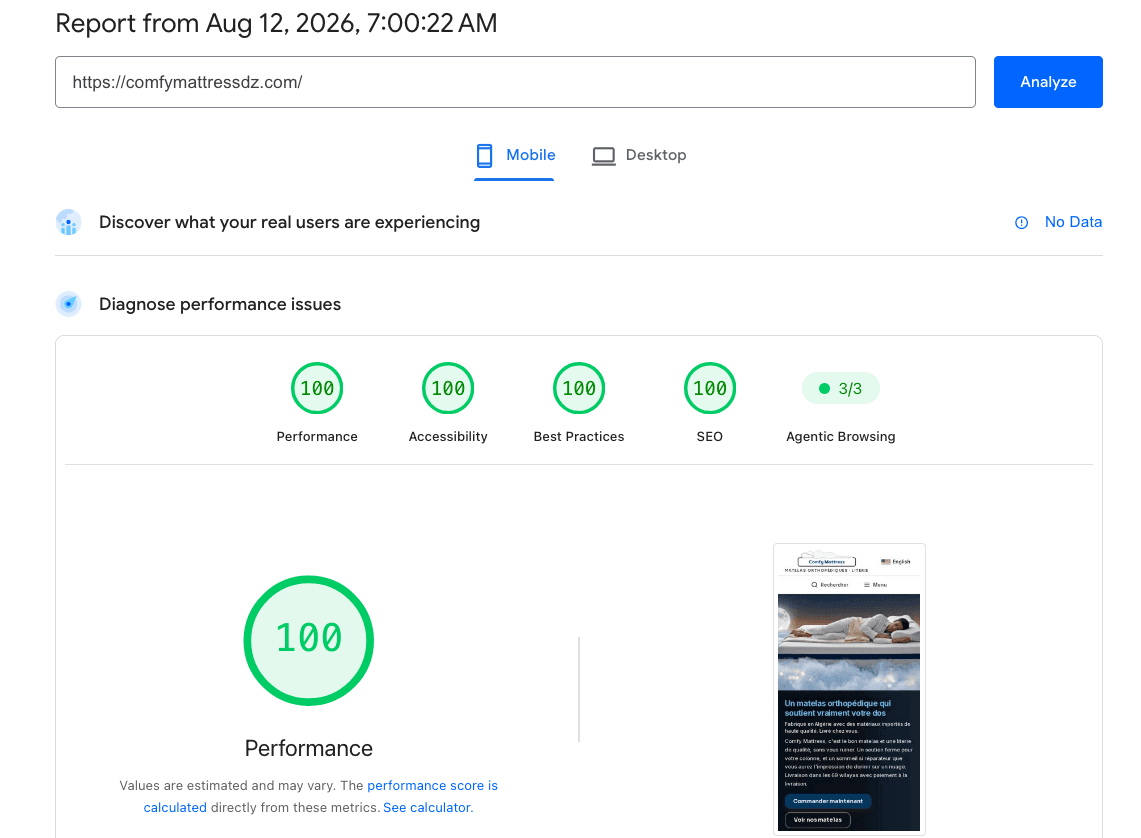
Performance 100 · Accessibility 100 · Best Practices 100 · SEO 100 · Agentic 3/3
Very little code sent to the phone
Many websites send a large amount of JavaScript code to the visitor's phone. The phone has to process all of it before it can show the page. On an average connection you can see it happen: the screen stays white, then the page appears in pieces.
The Comfy Mattress website is built with Next.js to send as little code as possible. The page arrives ready to display, and the phone has almost nothing to work out. That is one reason it shows up fast, even on 4G.
Lighter mattress photos, with no loss of quality
A bedding website lives on its photos: mattresses, pillows, bedrooms. If they aren't prepared properly, photos are what slow a site down the most.
Next.js shrinks and resizes each photo to fit the screen asking for it, with no visible loss of quality. A customer on a phone gets an image made for a phone, instead of the huge version meant for a big desktop screen.
Fewer plugins, fewer reasons to slow down
On WordPress or PrestaShop, each extra feature often comes from a plugin. Every plugin adds weight, and sometimes clashes with the others.
The Comfy Mattress website is custom-built, styled with Tailwind CSS, without piling on dozens of plugins. There are fewer parts that can slow the site down or break, and upkeep stays simpler.
What does the owner think?
The owner of Comfy Mattress left this review after launch: "The site looks modern and professional, and it loads super fast, even on my phone, which matters a lot to us and our customers." (5-star review)
That is exactly what the PageSpeed score measures: the speed a real visitor gets, on a real phone.
A score of 100 doesn't do everything
A fast site helps, but on its own it isn't enough. Comfy Mattress has only just launched, and its local ranking will build over time through the website, the Google Business Profile and social media.
Speed gives the site its best chance. Sales also come from good SEO, complete product pages and a well-kept Google Business Profile.
What about your business?
This kind of speed isn't only for big brands. It comes from a technical choice (Next.js), well-prepared photos and a site built without extras it doesn't need. See the full report and the Comfy Mattress story on our portfolio page, or find out how we build this kind of site on our web design page.
Selling online? We use the same approach for a full online store: see our Next.js e-commerce website design page.
Frequently asked questions
What does the Google PageSpeed score actually measure?
It measures four things, each scored from 0 to 100: performance (speed), accessibility (whether everyone can use the site), best practices (technical quality) and SEO (search basics). Comfy Mattress scores 100 on all four, on mobile and desktop.
Does a 100/100 score guarantee more sales?
No, not on its own. Speed helps visitors stay and counts for Google, but sales also depend on content, local SEO and the Google Business Profile. It gives you a solid base, with no guarantee attached.
Can a WordPress site also reach 100/100?
Yes, it's possible, but it takes much more tuning and upkeep, especially with plugins. With Next.js, a 100/100 score is easier to reach and easier to keep over time.
How long does it take to build a site this fast?
It depends on the number of pages and products. The Comfy Mattress website, bilingual and with several product ranges, was delivered quickly, as the owner says himself in his review. We always give you a clear timeline before we start.