

In Algeria, most customers visit your website on their phone, often over 4G. A slow site loses calls, orders and trust. Here is what slows a site down, what Google really says about speed, and how to tell where yours stands.
The problem: your customers won't wait
In Algeria, most people look for a product, a tradesperson or a restaurant right on their phone.
They are on the bus, at work, in front of a closed shop or at home in the evening. Their connection often runs on 4G, and its quality changes from one neighborhood and one hour to the next.
In those conditions, every second counts. When a page stays blank, the customer doesn't wonder whether the network or the site is to blame.

What they do is simple:
- They go back.
- They tap the next result.
- They call whoever's site opened first.
They don't hold it against you. They just want an answer, and someone else gives it to them faster.
The hard part is that you never see this customer. They didn't call, didn't write, and never saw your products or prices. For you, they never existed.
If your site gets visits but brings in few contacts, speed is one of the first things to look at.
What slowness really costs your business
A slow site doesn't only cost you visits. It costs you real contacts.

- Calls that never come, because the "Call" button shows up too late.
- WhatsApp messages and quote requests that are never sent.
- Orders abandoned before the customer even sees the product.
- Ad money wasted on clicks that lead nowhere.
Then there is trust. For a customer who doesn't know you, your website is often their first contact with you.
A sluggish site makes a business look poorly run. People wonder whether you answer the phone, deliver on time, or still exist.
Think about advertising. Many businesses pay Facebook, Instagram or Google to send visitors to their site. If the page is slow, some of them leave before seeing anything. We cover this in our guide to Facebook and Instagram ads in Algeria.
Finally, a slow site loses comparisons. A customer looking for a plumber in Blida often opens three or four sites. The slowest is often the first one dropped, even if it offers the best service.
What Google really says about speed
Google has long said that it uses more than 200 signals to rank pages.
- How relevant the content is to the question.
- The quality and reliability of the information.
- How trustworthy the site is.
- The visitor's experience, which includes speed.
So speed is one signal among many, not the only one.
One point matters a lot for you: Google looks at the phone version of your site first. It calls this mobile-first indexing.
If your site is fast on a computer but slow on a phone, the slow version is the one Google takes into account. And your customers on phones are the ones who suffer.
In a thread on Google's official Search Central help forum, a site owner asked whether a PageSpeed score of 45 would hurt their rankings. A forum expert with the "Diamond Product Expert" level answered.
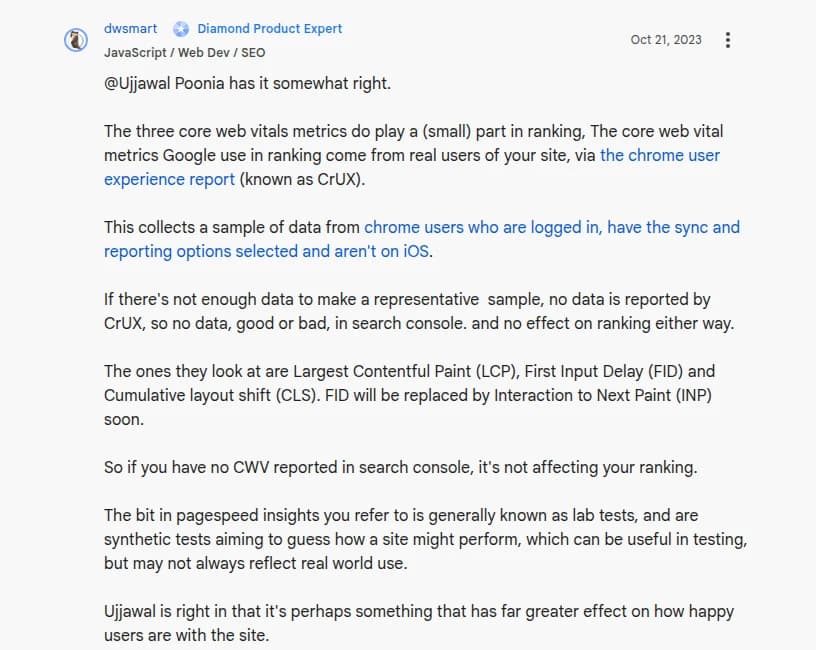
What to take away from the answer:
- The speed measurements used for ranking come from real visitors, through data from the Chrome browser.
- The score shown by PageSpeed comes from a simulated test. It helps find problems, but doesn't always reflect what your visitors experience.
- These measurements play a small part in ranking, and a much bigger part in how happy visitors are.
Put simply, a fast site will not jump ahead of a competitor who answers the customer's question better.
But when two pages are equally good, the visitor's experience can make the difference. Above all, speed decides what the customer does once they arrive: stay and contact you, or leave.
Be wary of anyone who promises you the top spot on Google through speed alone.
The three measurements Google looks at
Google sums up a page's experience with three measurements called Core Web Vitals. The names are technical, but the idea is simple:
- Main content display time (LCP): how long it takes to see the big image or headline at the top of the page.
- Responsiveness (INP): when the visitor taps a button, does the page react right away?
- Page stability (CLS): do things move around while the page loads, to the point of making people tap the wrong button?
These measurements describe what the visitor feels, not what the developer thinks.
A site can seem fast on the agency's computer with a good connection and still be slow for your customers on a low-cost phone over 4G.
When a site has too few visits to produce this data, it counts neither for nor against the site. The details are on Google's page on Core Web Vitals.
The forum thread dates from 2023 and still mentions a measurement called FID. Since March 2024, Google has replaced it with INP, which better measures how the page responds during the whole visit.
Common mistakes that slow a website down
Most slow sites combine several of these mistakes:
- Images that are too heavy, uploaded without being prepared for the web.
- A theme that does too much and plugins installed for no real reason.
- Special effects, slideshows and autoplay videos that are poorly chosen or badly built.
- Too many outside tools: analytics, chat windows, fonts, ads.
- Hosting that is underpowered, poorly configured or overcrowded.
Images first. Many photos are uploaded straight from a phone or a manufacturer.
They are sometimes dozens of times heavier than a phone screen needs. On an average connection, they hold up everything else.
Next comes the weight of the site itself. A theme built to do everything and a list of plugins installed "just in case" force the phone to read a lot of code.
Much of that code isn't even used on the page being shown. We compare both approaches in our article WordPress or Next.js: which website should you choose?.

Many owners also want a site with every effect possible. That is understandable: you want a site that impresses.
- Slideshows at the top of the page.
- Sliding text and scroll animations.
- Background videos.
- Pop-ups that open on their own.
But every effect has a cost. Chosen poorly or built badly, it adds weight and work for the phone.
The result: the customer sees your offer later, or never. A well-made effect can stay light. A badly made one can slow the whole page.
The small tools added over time count too. One by one they seem light. Together they can weigh a lot.
Hosting: the hidden side of speed
Your website lives on a computer called a server. Even a well-built site turns slow on a bad server.
It is like a good restaurant with a kitchen that is too small: the food is good, but it arrives too late.

On the hardware side, three things make every visitor wait before the page even appears:
- An old or underpowered processor.
- Too little memory.
- Slow disks.
Very cheap hosting plans often run on machines pushed to their limits.
On the software and setup side, the problems are less visible but just as real:
- Old versions of the server's software.
- No caching and no file compression.
- A setup done once, then never reviewed or maintained.
Two servers with the same hardware can perform very differently depending on how they are set up and maintained.
The most common problem is overcrowding. On cheap shared hosting, your site shares the same machine with a very large number of other sites.
When one of them gets heavy traffic, comes under attack or runs heavy tasks, all the others slow down.
And you don't know who your neighbors are. There may be adult websites, piracy sites or poorly protected sites. They often draw huge traffic and attacks, which eat up the power of the machine you share with them.
These neighbors can cause other trouble too:
- If a neighbor sends spam, the server's address can end up on blacklists.
- Your business emails may then land in your customers' spam folders.
- An unstable server can also make your site unreachable at times.
Google has explained that sharing a server is not a ranking penalty in itself. But a slow or unstable server is felt on every visit.
Distance matters too. The farther the server is from your visitors, the longer each exchange takes. For customers in Algeria, a well-placed, well-connected server makes a difference they feel without knowing it.
How to tell if your website is too slow
You can test your site for free with Google PageSpeed Insights, from a phone or a computer.
Look at the "Mobile" result first: it is the one that matters for most of your customers.

The tool shows two different things:
- At the top, when your site has enough visitors: data from real Chrome users. This is what Google uses.
- Below: a score out of 100 from a simulated test. It helps spot problems, but it can change from one test to the next.
So don't panic over a few points.
Do the customer test too. Open your site on your phone over 4G, without the office Wi-Fi, at different times of day.
Ask a friend or relative with an older phone to do the same. If you have to wait before you see your products or your number, your customers wait too.
A bad score doesn't always tell you where the problem comes from. Images, code, effects or the server can all be to blame, often several at once.
That is where an outside look saves time, before you spend money in the wrong place. Our technical SEO work is there to find the real cause.
What a fast website looks like
A fast website is easy to recognize:
- It shows the essentials right away: what you do, where you are, how to reach you.
- Its images stay sharp, but they are prepared for each screen size.
- Its effects are light, and each one has a reason to be there.
- It stays stable at peak times, when your customers are most numerous.
A fast site can be modern and pleasant to look at, with raised cards, buttons that respond to a tap and light animations.
Behind the scenes, the server is fast, well tuned and not overcrowded.
Our client Comfy Mattress scored 100/100 on PageSpeed with this kind of build, on a mattress store website full of product photos. Here is its real PageSpeed screenshot:
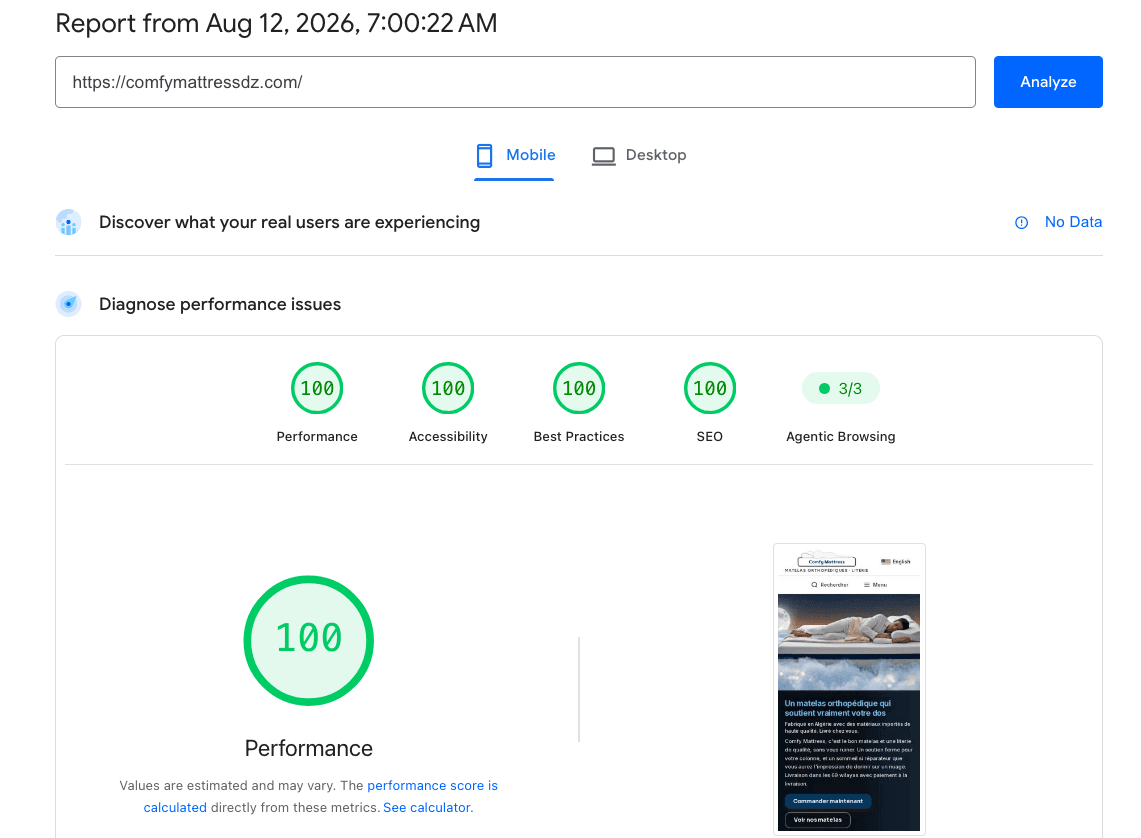
Performance 100 · Accessibility 100 · Best Practices 100 · SEO 100 · Agentic 3/3
The right questions to ask your web provider
If someone already manages your website, you don't need to become a technician. You only need to ask the right questions and listen for clear answers.

- What is my site's mobile score, and what does the real-visitor data say?
- How many other websites share the same server as mine?
- Where is the server, and who handles its settings and updates?
- Does every effect, plugin and tool on my site really serve a purpose?
- What was checked the last time the speed was tested?
A good provider answers simply, without jargon, and shows you measurements.
If they say the slowness comes from "the internet in Algeria" without checking anything, or that one more plugin will fix it, that is a warning sign.
Website maintenance also exists to keep a site fast over time, because a site that never gets attention ends up slowing down.
How SimplerWebs can help
We build our new websites with Next.js, a modern and lightweight technology, rather than with WordPress.
This lets us deliver sites that open fast on a phone, even on weak 4G, without depending on a stack of plugins that need watching.
- Hosting on our own server, tuned for speed, with a limited number of clients.
- Domain name and hosting: 14 900 DA a year. All our prices are on our pricing page.
- A speed test on a phone before every launch.
The goal is simple: your customers shouldn't leave while waiting for the page to appear.
Already have a website, even on WordPress? An SEO audit at 26 900 DA finds what is slowing it down and what is holding it back on Google.
If the problem comes from the very base of the site, a website redesign from 79 900 DA can cost less in the long run than patching it again and again.
Not sure where to start? Book a free 20-minute check by phone or video call. We look at your site with you and tell you plainly whether it is ready for your customers.
Frequently asked questions
How do I know if my website is too slow for my customers?
Test it with Google PageSpeed Insights and look at the "Mobile" result. Also open your site on your phone over 4G, without Wi-Fi. If you have to wait before seeing your products or your number, your customers wait too.
Does Google really punish slow websites?
Google uses many signals to rank pages, and speed is only one of them. The measurements it uses come from real visitors and play a small part in ranking. Their effect on your customers is much bigger.
Can cheap hosting slow down my website?
Yes, often. On cheap shared hosting, your site shares the machine with a very large number of other sites. When one of them gets heavy traffic or is attacked, all the others slow down.
Do animations and effects slow a website down?
Not always, but they always have a cost. A well-chosen, well-built effect stays light. Heavy slideshows, background videos or too many badly made animations can delay the whole page on a phone.
Can an existing site be made faster without rebuilding everything?
Often, yes. It depends on the cause: images, code, effects, added tools or the server. An audit shows what is really slowing the site down. When the problem comes from the very base of the site, a redesign is sometimes the most economical choice.