
Stuck between a WordPress site and a Next.js site? We compare both in plain words, with two real sites we built, so you can choose.
A choice to make before you build
You want a website, and the agency asks you: "WordPress or Next.js?" If neither name means much to you, that's normal. But the answer decides how fast your site is, how safe it is, what it costs and how much time you will spend looking after it.
There is no best choice for everyone. It depends on your business, your budget and the person who will run the site day to day. Below we explain both, with their real strengths and real limits, then show two live sites we built.
What is WordPress?
WordPress is a content management system (CMS). It is a ready-made tool that runs a large share of the world's websites. You log into a dashboard, then write your pages, add photos and change your text yourself.
You add features with plugins and change the look with themes. It is flexible, and plenty of people know how to use it, in Algeria and everywhere else.
What is Next.js?
Next.js is a technology for building a custom website. There is no ready-made theme: the site is coded for your needs, page by page. It only loads what the page actually uses, which is why it is so fast.
It is what our team prefers for most projects at SimplerWebs. A site that is fast and safe from day one makes a real difference when a customer finds you for the first time on their phone.
WordPress: the strengths
- You manage your own text and photos, with no coding.
- Thousands of plugins to add a feature quickly (a form, a gallery, bookings).
- Often a lower starting cost, because part of the site already exists.
- Easy to find someone who knows it if you ever change provider.
- Handy for a blog or a site you edit very often.
WordPress: the limits
- It often slows down as plugins and heavy themes pile up.
- It is the CMS hackers target most, because it is the most widespread. Most known security holes come from plugins, which is why updates matter so much.
- An update can break a plugin, or two plugins can clash with each other.
- Upkeep takes time: updates, backups and security checks.
- Making it truly fast on mobile takes tuning, and that tuning has to be redone over time.
Next.js: the strengths
- Very fast out of the box, which helps both your visitors and your place on Google.
- Fewer ways in for hackers: no public login page and no stack of plugins to watch.
- Custom-built: the site does what you need, with no unused features weighing it down.
- A top speed score from launch day. Google's real-visitor data (Core Web Vitals) takes a few weeks to appear, once real people have used the site.
- Less day-to-day security work.
Next.js: the limits
- The starting cost is often a little higher, because everything is built for you.
- There is no built-in editor like WordPress has. If you want to edit content yourself, we add a visual editing tool as an option, from 24,900 DA. It does not slow the site down.
- Without that editor, our team makes the content changes for you.
- Fewer ready-made features: each feature is built for your site.
Speed and SEO: where they really differ
In Algeria, most visitors reach your site on a phone, often on 4G. If the page takes a long time to open, many leave before they see your offer. Google pays attention too: page speed and stability are part of what it measures.
Next.js starts with a head start here. WordPress can be fast, but it has to be tuned with care, and the tuning has to be kept up over time.
Speed is only part of it. To be found on Google you also need good text, a clear structure and ongoing search engine optimization (SEO). A fast site with nothing useful on it stays hard to find.
Two real examples, in Algeria
To make this concrete, here are two sites we built. Comfy Mattress, a mattress shop in Algiers, is built with Next.js and Tailwind CSS. On Google PageSpeed it scores 100 in all four categories, on mobile and desktop, plus 3/3 on Agentic Browsing.
Prayer Travel Services, a travel agency in Bir Mourad Raïs, runs on WordPress. It ranks #1 on Google locally for "agence de voyage Bir Mourad Raïs" and scores 100 for SEO on PageSpeed. Its mobile performance score is 69. That's fine, but it would need more tuning to get as high as the Next.js site.
Together they show both sides of the choice. A WordPress site can rank very well when the SEO work is done right. Next.js gives you top speed from the start. You can see both sites and their scores on our Portfolio page.
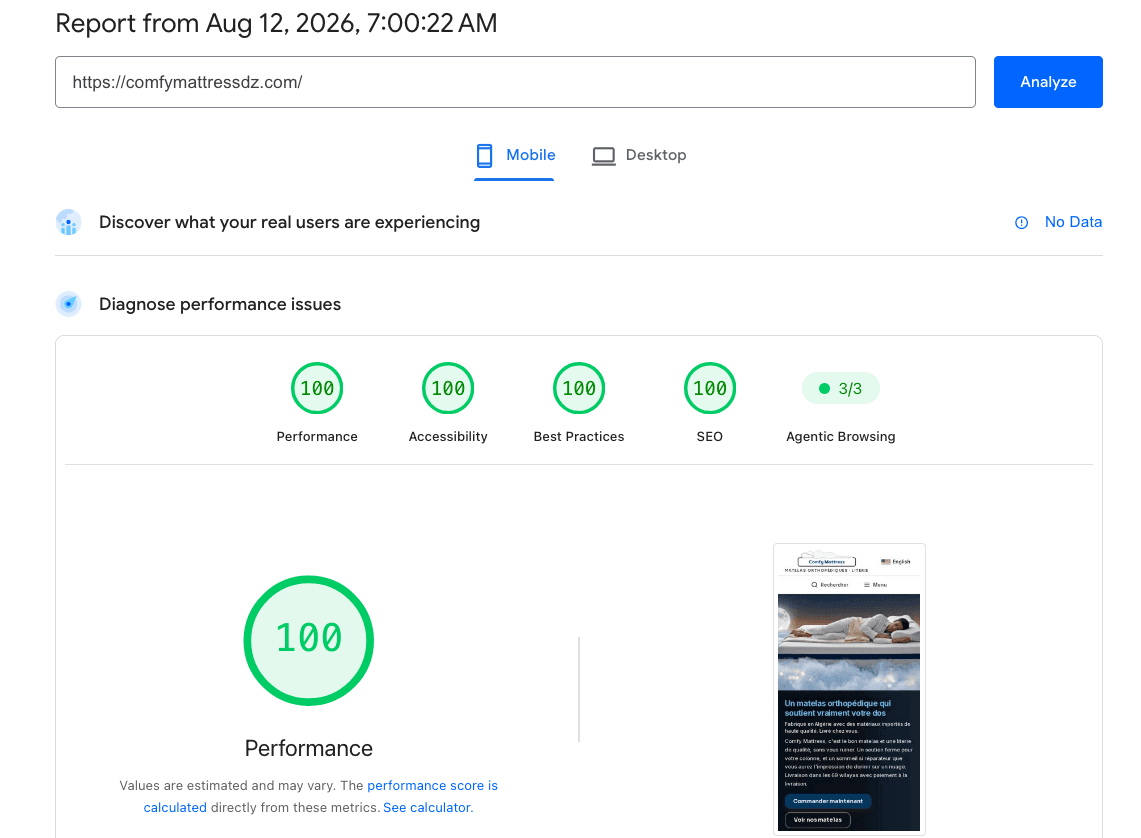
Performance 100 · Accessibility 100 · Best Practices 100 · SEO 100 · Agentic 3/3

Performance 69 · Accessibility 90 · Best Practices 96 · SEO 100 · Agentic 1/3
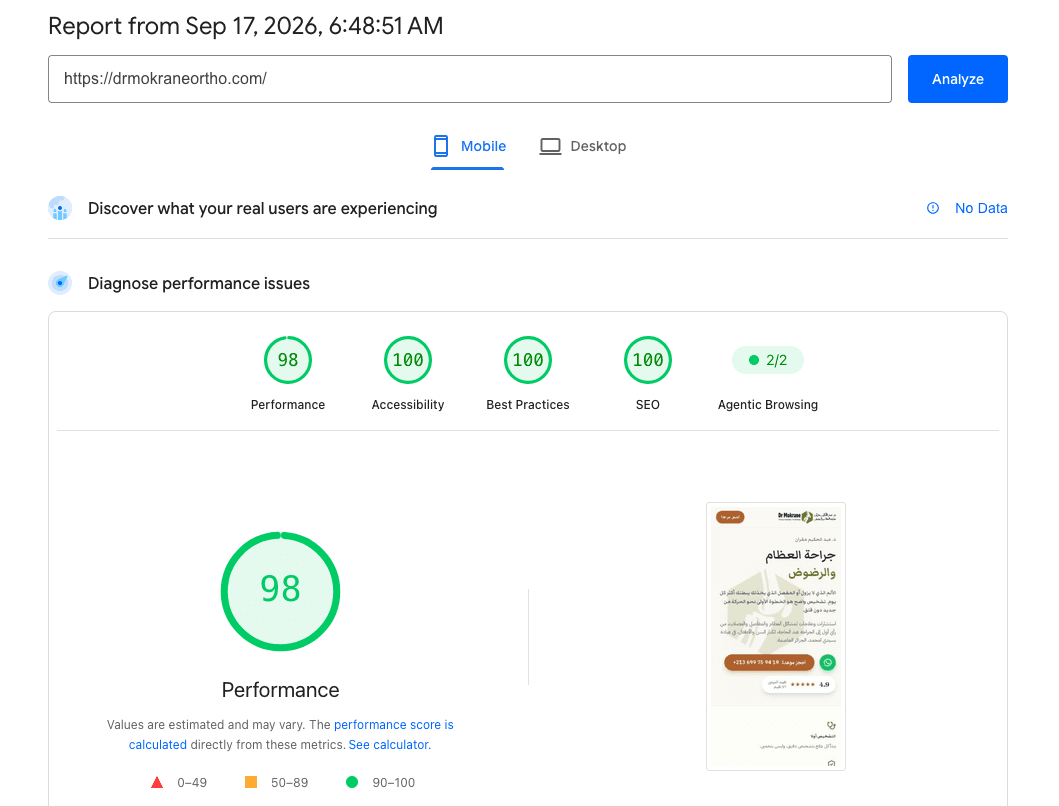
Performance 98 · Accessibility 100 · Best Practices 100 · SEO 100 · Agentic 2/2

Performance 92 · Accessibility 100 · Best Practices 100 · SEO 100 · Agentic 3/3
Google PageSpeed Insights reports (mobile), July 2026. The same care, two different technologies.
Security and upkeep
WordPress is everywhere, so hackers go after it first. A WordPress site needs regular updates, backups and monitoring. When nobody looks after it, plugins get old and become a way in. We give the real numbers in our article on WordPress security risks.
A Next.js site has far fewer ways in. It still needs some care (hosting, small updates), but much less day-to-day security work.
Whichever you pick, ask who looks after the site once it is live. With us, website maintenance is an option, from 28,900 DA per year.
Who runs the site: you or us?
This question often settles it. Do you want to change your text and photos yourself, or would you rather we handle it?
- You want to edit everything yourself, often? WordPress makes daily editing easy.
- You'd rather not think about it? We run your Next.js site and make the changes for you.
- You want both? We add a simple editing tool to your Next.js site, from 24,900 DA, and it stays fast.
What about the price?
Our website pricing page lists fixed prices in dinars: a single page at 34,900 DA, a Pro Showcase site (up to about 6 pages, built with Next.js) at 89,900 DA, and an online store from 219,900 DA. Every site is built SEO-friendly (fast, clean structure); ongoing SEO is a separate service.
A WordPress site can sometimes start a little lower, because part of it already exists. Also count what comes back every year: hosting, the domain name and upkeep. On WordPress, upkeep weighs more. Our guide how much a website costs in Algeria goes through all of these costs.
So, which one should you choose?
A simple guide by situation:
- A business site that has to be fast and look trustworthy: Next.js.
- A blog you update yourself every day: WordPress can be enough.
- An online store: both work. We choose based on your catalog, your budget and who handles the orders.
- As little upkeep as possible: Next.js.
- A small starting budget and you want to run everything yourself: WordPress.
- You want to edit the content yourself and keep the speed: Next.js with the optional editor.
SEO works on both
Ranking on Google does not depend on one tool. We do SEO for Next.js, WordPress and Joomla sites, and for WooCommerce, PrestaShop and Shopify stores. If you already have a site, we can often improve it without rebuilding it.
Setting up an online store? We compare the platforms, with the realities of the Algerian market (cash on delivery, Edahabia, CIB), in Which E-commerce Platform in Algeria?
Even a perfect site still has to be found. Read why a Facebook page is not enough and what to add so people find you on Google and on Maps.
Our recommendation
For most businesses we suggest Next.js. Speed, security and a professional look count for a lot when a customer finds you on their phone. If you want to run everything yourself on a small budget, WordPress is still a good choice, and we set it up so it is clean and as fast as it can be.
Still not sure? Tell us about your business. We will tell you honestly what suits you, even if it is the cheaper option. The first conversation is free, with no commitment.
Frequently asked questions
Is Next.js better than WordPress for SEO?
Not by itself, but it helps. Next.js gives you a fast site from the start, and speed matters to Google and to your visitors. Rankings depend mostly on content and SEO work: a well-optimized WordPress site can rank #1 locally, like Prayer Travel Services does.
Can I edit a Next.js site myself?
Yes, if we add the optional visual editing tool, from 24,900 DA. Without it, our team makes the content changes for you.
My site already runs on WordPress. Do I have to start over?
Not necessarily. We can often speed it up, secure it and improve its SEO without rebuilding it. If the site is too slow or too old, a redesign can be worth it: redesigns start at 79,900 DA on our pricing page.
How long does it take to build the site?
A single page takes about one week and a full showcase site two to three weeks. We give you a clear date before we start, whether the site is WordPress or Next.js.