

PrestaShop, WooCommerce, Shopify or Next.js? How to pick a platform for your store in Algeria: cash on delivery, speed and cost.
You want to sell online, but the choice is confusing
You have good products and maybe some customers already, on Facebook or Instagram. Now you want a real online store. As soon as you ask for advice, four names come up: PrestaShop, WooCommerce, Shopify and Next.js. Each one has its fans, and each fan says their tool is the best.
The right choice depends on your situation: how your customers pay, what phone they shop on, how much you can spend, and who will handle the orders every day.
Below we compare the four options in plain words, with their real strengths and real limits for a store in Algeria.
First, how people buy online in Algeria
Many platforms are designed for countries where almost everyone pays by card. In Algeria, online shopping works differently, and that changes which tool makes sense.

Photo: Liza Summer on Pexels
- Cash on delivery dominates: most customers pay in cash when their order arrives. Your store has to handle that simply.
- Online payment exists: Edahabia and CIB cards, through the SATIM interbank platform, let people pay on a website. Some of your customers already use them.
- Stripe does not work for Algerian businesses, and PayPal is very limited here. These tools often come built into foreign platforms, but they do almost nothing for you.
- Most customers shop on a phone, often on 4G. A heavy store loses sales every day.
How to judge a platform
A long feature list doesn't tell you much. For a store in Algeria, ask these six questions about each option:
- Is cash on delivery easy to manage, with tracking of paid and unpaid orders?
- Does the store stay fast on a phone with an average connection?
- What does it cost to launch, and what does it cost each month or year after that?
- Who runs it day to day: you alone, or a team that handles everything?
- Can it accept Edahabia and CIB cards?
- Can you add products, pages and features later without starting over?
PrestaShop: the classic that is everywhere in Algeria
PrestaShop is online store software. The base is free, and it is very common in Algeria. Many local developers know it, so help is easy to find.
It handles cash on delivery out of the box, and there are modules made for the Algerian market, for example to connect with delivery companies. That is a real plus here.
- For: well suited to Algeria, can handle a large catalog, lots of modules.
- For: you manage your products and orders from a dashboard.
- Against: it needs upkeep (updates, security, backups), or it ages badly.
- Against: without careful tuning it gets slow, especially with many modules.
WooCommerce (WordPress): flexible, but needs watching
WooCommerce is a plugin that turns a WordPress site into a store. If you already know WordPress, you will feel at home quickly. You add features with more plugins.
Cash on delivery takes a few clicks to switch on, and plugins handle local payment methods. The downside: every plugin you add makes the store a bit heavier, and some of them clash with each other.
- For: familiar if you come from WordPress, very flexible, a huge choice of plugins.
- For: a good fit if you also publish a lot of content (a blog, guides).
- Against: too many plugins slow the site down and cause conflicts.
- Against: like PrestaShop, it needs regular updates and monitoring.
Shopify and BigCommerce: easy, but built for other markets
Shopify and BigCommerce are hosted, ready-to-use stores. You don't deal with servers or updates, and launching is genuinely simple.
The problem is payment. The subscription is billed every month in foreign currency, which is expensive and awkward to pay from Algeria. And Shopify's built-in card payments (Shopify Payments) are not available in Algeria.
In practice you end up using cash on delivery and manual methods, while paying a foreign subscription for features you don't use.
- For: very easy to launch, nothing to maintain, good-looking themes from the start.
- Against: a monthly subscription in foreign currency that is hard to pay from Algeria.
- Against: the built-in card payment does not work here.
A custom Next.js store: our pick for speed
Next.js is a technology for building a custom store. The site is coded for your needs, with no unused themes or plugins, and that is what makes it so fast.
For Algeria the benefit is practical: we build cash on delivery exactly the way you handle it, and we can connect Edahabia and CIB without relying on a foreign plugin. Online card payment is an option with its own price, written in the quote.
It is our preferred approach when speed matters. See our custom e-commerce store design service and the results in our work in Algeria.
- For: the fastest store on mobile, from day one.
- For: a checkout built around cash on delivery, the way your customers are used to buying.
- For: fewer ways in for hackers, so less security upkeep.
- For: a changed price or stock level shows up within seconds, with no site rebuild.
- Against: a higher starting cost (from 219,900 DA with us).
- Against: no ready-made dashboard like PrestaShop's. We run the site for you, or add an editing tool as an option.
Why speed matters so much on mobile
Most of your customers will open your store on a phone, often on 4G. If the photos are slow to appear and the "Order" button takes a while to respond, many give up before they reach the cart.
Google also takes page speed and stability into account. A fast store helps your sales and your place in the results.
Here are two real sites we built, with their Google PageSpeed scores. The Next.js site scores 100 for performance on mobile. The WordPress site scores 69: fine, but it would need more tuning to get close. A fast website keeps more customers all the way through checkout.
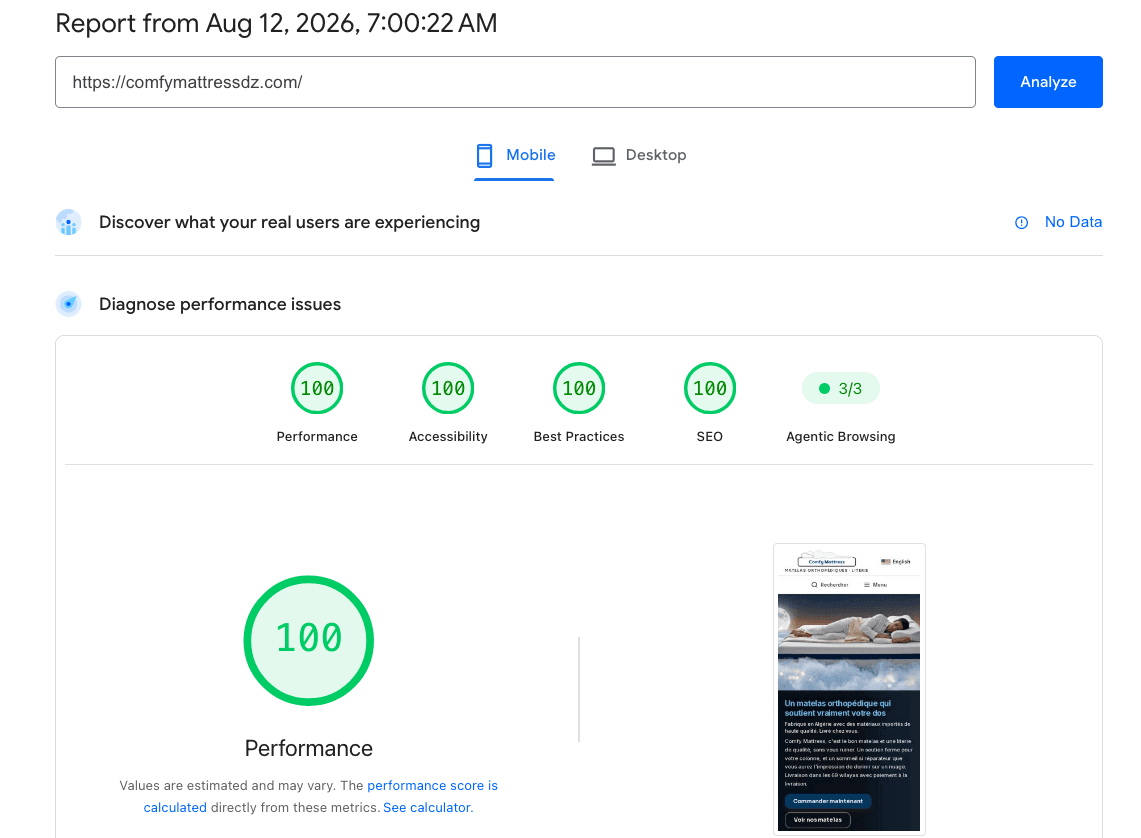
Performance 100 · Accessibility 100 · Best Practices 100 · SEO 100 · Agentic 3/3

Performance 69 · Accessibility 90 · Best Practices 96 · SEO 100 · Agentic 1/3
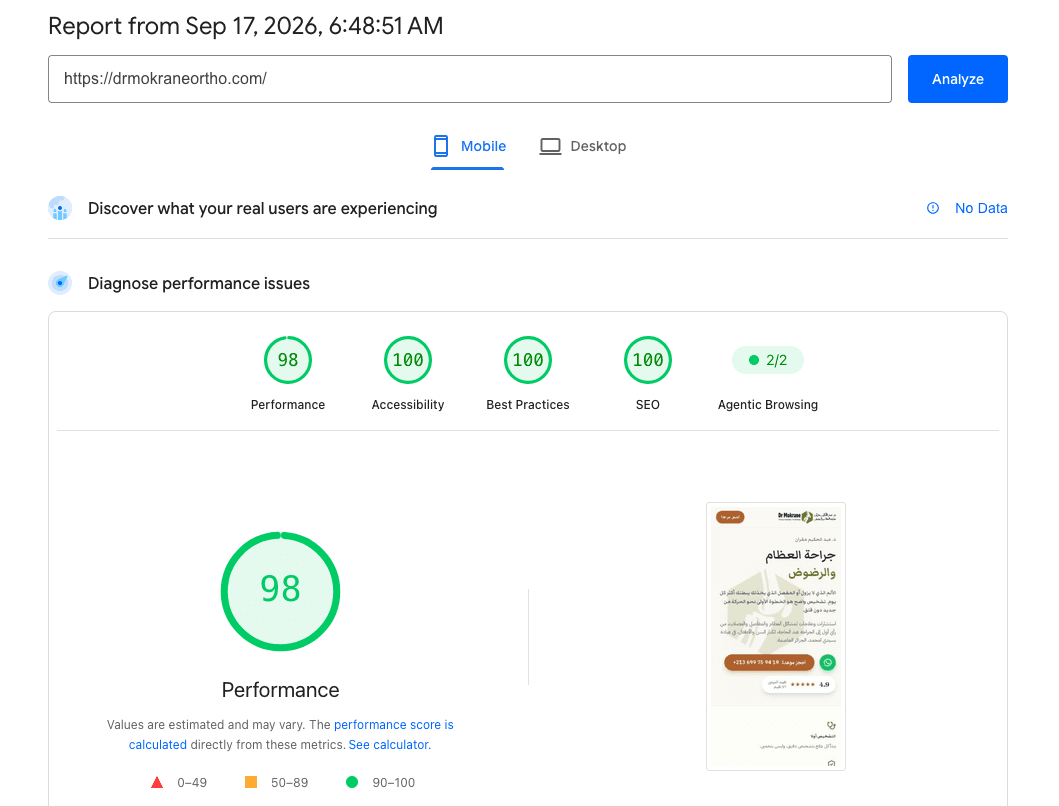
Performance 98 · Accessibility 100 · Best Practices 100 · SEO 100 · Agentic 2/2

Performance 92 · Accessibility 100 · Best Practices 100 · SEO 100 · Agentic 3/3
Google PageSpeed Insights reports (mobile), July 2026. The same care, two different technologies.
Payments in Algeria: how each platform copes
This is where many e-commerce projects get stuck. These are the payment methods that matter here:

Photo: Leeloo The First on Pexels
- Cash on delivery: the customer pays in cash when the order arrives. It is the most used method.
- Edahabia and CIB online: the customer pays by card, through SATIM.
- BaridiMob and CCP: transfers through Algérie Poste, useful as a manual method.
- Stripe and PayPal: no use for collecting payments from your Algerian customers, even when they come built in.
Which platform handles these payments best?
PrestaShop and WooCommerce handle cash on delivery well, and local modules add Edahabia and CIB. Shopify and BigCommerce handle delivery, but their built-in card payment is no use here. A Next.js store connects only the methods that work for you.
Whatever the tool, aim for a short checkout, in the language your customers read, that reassures them and offers every local payment method.
So, which one is right for you?
There is no winner for everyone. A simple guide by situation:
- Small budget and you want to run everything yourself right away: PrestaShop or WooCommerce.
- You want the best speed and a checkout built for your business: a Next.js store, which we run for you.
- You are testing an idea with a few products: start simple, you can move up later.
- You are already on WordPress and publish often: WooCommerce.
Whatever you choose, SEO decides whether people find you
A good-looking store that nobody finds on Google sells very little. The platform alone is not enough: customers have to land on your products when they search for them.
SEO does not depend on the tool. We do SEO for online stores on PrestaShop, WooCommerce, Shopify and Next.js.
Well-written product pages, clear categories, light images and a clean structure: that is the search engine optimization (SEO) work that brings free visits, month after month.
Our honest recommendation
For a store that is meant to last and that sells mostly on mobile, we recommend Next.js. It is faster, and we build cash on delivery and card payment around the way you work.
If you want to run everything yourself on a small starting budget, PrestaShop or WooCommerce are still very good choices. We set them up so they are clean and as fast as they can be.
Not sure yet? Tell us about your products and your budget. We will recommend what suits you, even if it is not the most expensive option. The first conversation is free, with no commitment.
Frequently asked questions
Does the platform support cash on delivery?
Yes, the right ones do. PrestaShop, WooCommerce and a custom Next.js store all handle cash on delivery, with tracking of paid and unpaid orders. It is the most used payment method in Algeria, so we always set it up first. See our e-commerce store design service for details.
Can I accept Edahabia or CIB payments online?
Yes. Through SATIM, a store can accept Edahabia and CIB cards. On PrestaShop and WooCommerce we add a local module; on a Next.js store we build the payment step for you. It is an option with its own price, shown in the quote. Stripe and PayPal can't be used to collect payments from your customers in Algeria.
Which platform is cheapest to start with?
PrestaShop and WooCommerce, because the software is free: you mainly pay for the build and the hosting. Shopify charges a monthly subscription in foreign currency. A Next.js store costs more up front (from 219,900 DA with us), but it is faster and needs less upkeep. See our pricing.
Can I switch platforms later?
Yes, but it takes time and costs money: products and orders have to be moved, and part of the site rebuilt. It is better to choose well at the start. If you're unsure, our guide WordPress vs Next.js: which website to choose? can help.
Do you do SEO for all of these platforms?
Yes. We do SEO for online stores on PrestaShop, WooCommerce, Shopify and Next.js: product pages, categories, speed and structure. Monthly SEO for a store is part of our Pro / E-commerce plan, at 63,900 DA per month.