
'Near me' has become one of the most common ways to look for a business. Here is what matters to show up there, without jargon.
"Near me" has become a normal way to search
A customer needs a plumber, a pharmacy that's open late, or a car parts shop. They take out their phone and type "plumber near me." They don't want a list covering the whole city. They want someone close by who can help now.
Google has published figures on this habit. On mobile, "near me" searches that include buying words (like "where to buy... near me") grew by more than 500% over two years, according to Think with Google. Those are US figures, but we see the same habit here: people search from their phone, often just before they head out or make a call.
Hyperlocal SEO is the work that helps you show up in these nearby searches, on top of the general searches for your city.
"SEO in Algiers" and "near me": two different customers
Going after a whole city and going after one point on the map are two different jobs. A search for "web agency in Algiers" comes from people all over the capital, and some of them are only comparing, not ready to decide. A "near me" search comes from someone looking right there, right now, who will often call or walk in within the hour.
So a business that ranks well for "[your trade] in Algiers" can still lose customers to a lesser-known competitor that shows up better in nearby searches.
What Google looks at for a "near me" search
Google says it ranks local results on three things: relevance (does your business match the search), distance, and how well known the business is. You can't do anything about distance. For the rest, these points matter:
- An up-to-date Google Business Profile, with the right category and the right service area. An area that is too wide or badly set hurts you.
- Real, recent customer reviews, with your replies. A profile left alone for months inspires less trust than one that someone looks after. See also why replying to Google reviews matters.
- The same name, address and phone number everywhere online: on your website, your Google profile and your Facebook page.
- Content that really talks about your neighborhood or area, instead of repeating the city name.
Distance: why every customer sees a different result
Distance is the one factor you have no control over. But it helps to understand how it works. Google explains it in its page on how local ranking works in Google: it works out the distance between the business and the place of the search. If the search doesn't name a place, it uses what it knows about the person's location, often the location of their phone.
The direct result: there is no single "near me" ranking. A customer in El Biar and a customer in Kouba who type the same search don't see the same list. Sometimes moving to the next street is enough to change the order.
That's why many business owners get their visibility wrong. They search for their trade from inside their shop, see themselves at the top, and think everything is fine. From their own premises, they are of course close. The customer who lives two kilometers away may see something completely different.
Distance isn't everything, though. A business a little farther away, but with a complete profile, good reviews and a clear website, can come out ahead of a closer business with poor information. That's where your work makes a difference.
Addresses without numbers, neighborhoods and landmarks: the Algerian case
In Algeria, many addresses don't look like the ones Google knows best. No street number, a housing estate with a name and a building letter, a locality name, or simply "next to the mosque" or "across from the post office." Everyone in the neighborhood understands. A map understands much less.
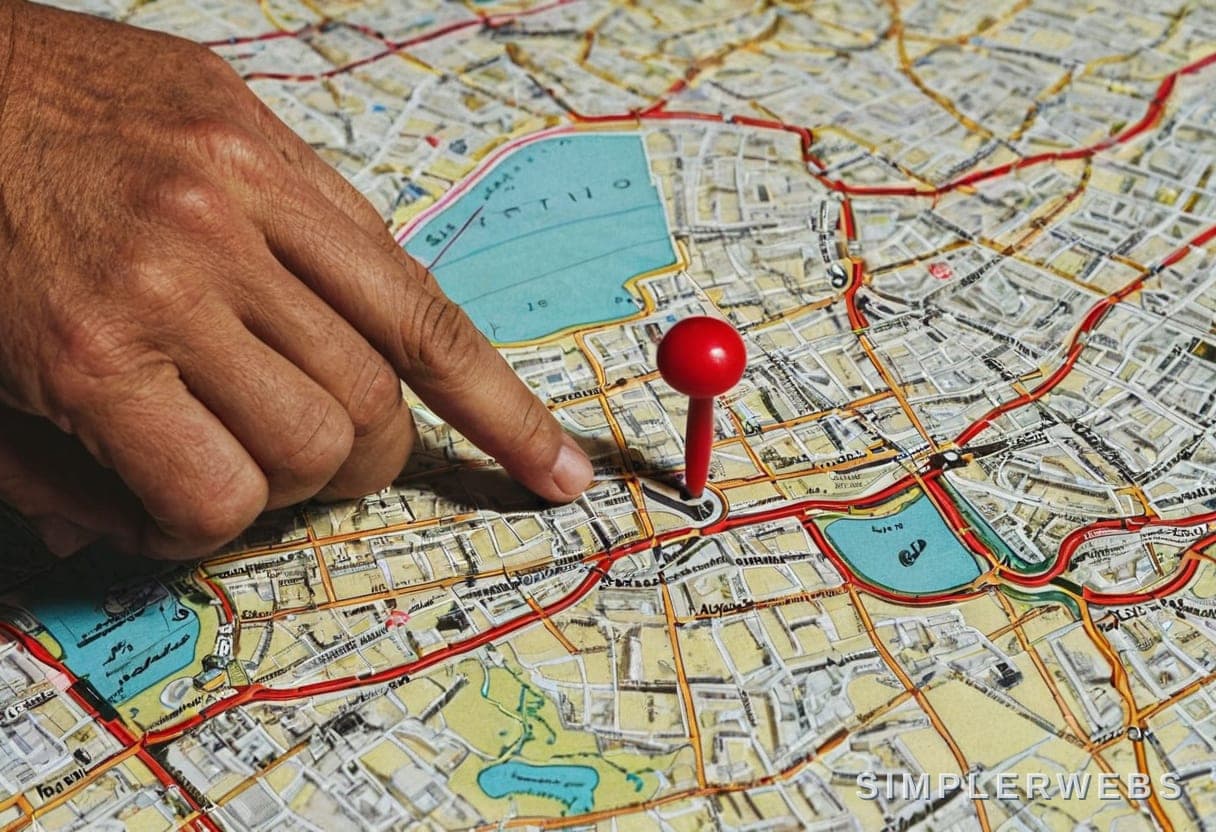
The first risk is a pin placed in the wrong spot on Google Maps. If your point on the map is a few hundred meters from your real shop, the distance Google calculates is wrong. The customer follows the directions, arrives at the wrong place, calls you, or gives up. And sometimes they leave a bad review for a mistake that wasn't theirs.
This mistake travels far. Here, people often share an address by sending a Google Maps link on WhatsApp or in a Facebook comment. If your pin is wrong, every share sends the customer to the wrong place. A single correction on the map fixes the problem for all those shares at once.
The second risk is names. The same neighborhood can have an official name and a name everyone actually uses. A commune can be spelled two ways, like Kouba or Koubba, Hussein Dey or Hussein-Dey. Your customers search with the words they use every day. If your website and your profile never use those words, the link between you and the neighborhood stays weak.
Well-known landmarks also matter to your customers. A text saying you are near a certain market, station or roundabout helps people place you. It also shows that you really know the area.
A shop or a business that travels: two different situations
Not every business has premises where customers come in. A plumber, a tow truck driver, an air conditioning repairer or a home tutor goes to the customer. Google calls this a service-area business.
For these businesses, Google asks you not to show the address if customers don't go there, and to list the areas you serve instead: communes, a wilaya, neighborhoods. This is often the case for tradespeople who work from home. Showing your home address doesn't help, and it isn't wise either.
There is a trade-off to understand. Even with the address hidden, Google knows where you work from. Listing all of Algeria as your area won't make you show up in Oran if you are based in Blida. A realistic area that matches the places you really go to is more believable, for Google and for your customers.
Some businesses fit both cases: a shop people visit, plus a delivery or call-out service. The profile then has to show both, with no contradiction between the address, the service area and what your website says.
Fake addresses: a shortcut that ends badly
Because distance counts, some people try to get around it. They create a profile with a relative's address in a busier neighborhood. Or one profile per commune, without premises in any of them. Or a virtual office address, just to get a point on the map.
Google's rules are clear: a profile must match a real place where the business meets customers during its opening hours, or else be a service area with no address shown. Made-up addresses and duplicate profiles for the same business are not accepted.
The risk is suspension. The profile disappears from Google Maps, along with its reviews, right when you were counting on it. Getting it back takes proof and time, with no guarantee. Our article on the risks of setting up a Google profile yourself describes what happens in that case.
There is also a simpler risk: the customer. They arrive at an address where there is nothing. They don't come back, and sometimes they say so in a review. For a few weeks of visibility, you lose trust for a long time.
AI answers more and more before anyone clicks
For a "near me" search, Google sometimes shows an answer written by its AI that names one or two businesses before the usual list. Our article on Google's AI Overview explains how that answer is put together.
It draws on the same information listed above: Google Business Profile, reviews, website content. If that information is incomplete, you can lose visibility without your usual ranking showing it. That is what our AI SEO service is about.
Neighborhood content counts more than city content
Our web design pages by city currently cover the wilaya level: Algiers, Oran, Constantine and the others. That's a good base. Each page speaks to the trades of its city: our web design in Oran page talks about restaurants and wedding halls, and our web design in Tizi Ouzou page about building trades. Hyperlocal SEO goes further, with content that names a real neighborhood, a real street, a landmark local people know.
To be upfront: our own city pages don't go down to that level of detail yet. If your business depends on one particular neighborhood, we can work out together what content to add to your website.
The mistakes we see most often
In the profiles and websites we look at, the same mistakes keep coming back. None of them is made on purpose, but each one weakens your place in nearby searches.
- Neighborhood names added to the profile name, like "Plumber Hydra Ben Aknoun Kouba." Google asks for the business's real name, and this kind of addition can lead to a suspension.
- Website pages copied for every commune, with only the name changed. Visitors notice right away, and these pages bring very little.
- One phone number on the profile, another on Facebook, a third on the website. The customer doesn't know which one to call, and Google sees information that doesn't match.
- A website with no address, no map and no service area. That makes it hard to connect your website to a specific place.
- A main category that is too vague or simply wrong. The profile shows up for searches that have nothing to do with you, and not for the ones you care about.
- Photos found on the internet instead of photos of your shopfront, your sign or your job sites. A photo of the entrance helps customers recognize you when they get there.
Ramadan, Eid, summer: when nearby searches change
"Near me" searches follow the rhythm of the country. During Ramadan, people look for a pastry shop, a bakery or a restaurant at unusual hours, often in the evening after iftar. Before Eid, it's butchers, children's clothing and hairdressers. In summer, coastal towns welcome visitors who don't know the streets and rely on their phone.
At these times, wrong opening hours do more damage than usual. A customer who finds your shop closed when Google says it's open is let down. They may leave a review, and they'll go to the shop next door next time.
Google lets you set special hours for holidays and particular periods. Many business owners don't do it, or do it too late. It's a small detail, but it's often what separates a profile people trust from one they avoid.
The same problem affects neighborhoods that change: a new market, a road closed for works, a shop that moves a few streets away. A profile that isn't updated sends customers toward a situation that no longer exists.
Signs that your neighborhood visibility has a problem
You don't need a tool to spot a problem. Some signs come straight from your customers and your daily routine:
- Customers from the neighborhood tell you they didn't know you existed, even though you've been there for years.
- People often call to ask where exactly you are, even after seeing your profile.
- A competitor farther away than you shows up first when someone searches from your street.
- Your profile gets views, but few calls or direction requests.
- Customers arrive at the wrong place, or complain about the directions in a review.
- Most of your customers come from far away, and very few from the streets around you.
What we do with you, and what we refuse to do
Hyperlocal work doesn't require cheating. It requires precision: a pin in the right place, a readable address, a realistic service area, the same information everywhere, and a website that talks about your real neighborhoods in the words your customers use.
If what you mostly need is a well set-up Google profile, a one-time profile optimization costs 12,900 DA. If you want month-to-month work that also covers the technical basics of your website, the Local Starter plan is 19,900 DA per month.
What we refuse: fake addresses, duplicate profiles, fake reviews, and profile names stuffed with keywords. These methods can give a quick effect, then make you lose everything. We prefer slower work that lasts.
Three things to check today
You don't need a complicated tool. Pick up your phone and run these checks:
- Search for your type of business followed by "near me," and see who comes up first.
- Check that the address, opening hours and phone number on your Google Business Profile are correct today.
- Read your pages again: do they mention a real neighborhood or area, or only the city in general?
How SimplerWebs helps
- Local SEO: we work on the signals that count for "near me" searches, on top of your general ranking.
- Google Business Profile: setup, improvements and corrections, so Google has the right information to show.
- AI SEO: we also prepare your content for AI-written answers, which show up more and more on nearby searches.
In short
"Near me" is now one of the most common ways people find a business. An up-to-date Google Business Profile, real recent reviews and content about your area often count for more than a good ranking on a city keyword.
Want to know where you stand in searches around your neighborhood? We can check it with you.
Frequently asked questions
What is hyperlocal SEO, in one sentence?
It is the work done to show up in very precise searches, like "near me" or searches tied to a neighborhood, and not only in searches covering a whole city.
Does hyperlocal SEO replace classic local SEO?
No, it adds to it. Local SEO already covers the city and the wilaya. Hyperlocal SEO goes down to the neighborhood.
Do I need a separate page for every neighborhood?
Usually not. Adding real neighborhood content to your existing pages is often enough. Piling up near-identical pages doesn't help.
Is a Google Business Profile enough on its own?
No. It counts for a lot, but Google also looks at your website, your reviews, and whether your information is the same everywhere online.
How long before I see an effect?
It depends on where you start and on your competitors. A corrected Google Business Profile can move within a few weeks. Neighborhood content on your website takes longer, often several months. Nobody can promise a date.
I work from home. Should I show my address on Google?
No, if your customers don't come to you. Google plans for this case: you hide the address and list the communes or neighborhoods where you work. It's safer for you, and it follows Google's rules.
Can I create a Google profile for every neighborhood I work in?
No. A profile matches a real place where you meet customers, or a service area. Duplicate profiles or profiles with made-up addresses risk being suspended. One well-kept profile is better.
Why does a competitor who is farther away show up before me?
Because distance is only one of the factors. If their profile is more complete, their reviews more numerous and recent, and their website clearer about their area, they can come out ahead of you. Those are exactly the points we can work on.